Last updated on July 23rd, 2026
In Northern Nevada, in a beautiful place where the wind brushes through the mountains, sits the town of Winnemucca. You might drive past this quiet town on Interstate 80 and see an old, classic American railroad hub. However, it’s not just old, rusted metal—underneath Baud Street lies buried a time capsule and tons of history. It reveals the Chinatown that once flourished in the northern Nevada desert.
Winnemucca’s Chinatown was born from hard work, dedication, labor and iron. In the 1800’s, the Central Pacific Railroad, directed to the Nevada desert, was primarily powered by tons of working Chinese immigrants. After the spike was over and heavy construction was completed, many of those workers chose to stay in the unfamiliar, but strived for better. Instead of returning to their homes, they chose to stay in Winnemucca.
In the late 1800s, the local Chinese community was scattered across the area, separated by family and social groups. Life in Chinatown was great, and during its peak in the 1890s, the town housed about 400 people, with only four being women.
The architecture of the town said a lot because building materials were expensive out in the desert, leaving them to be really smart with the very little they had. Many common materials were wood, adobe, and leftover metals they had, like tins. They were determined to make something out of nothing and managed to nail it, having a place to call home. However, facing discrimination and getting over that barrier wasn’t quite as easy.
In Chinatown, everyone worked together from bringing fresh fish from Sacramento to building large vegetable gardens. Being a miner was a common job, but the community was also a main produce supplier for the surrounding locals, really showing how a community should be.
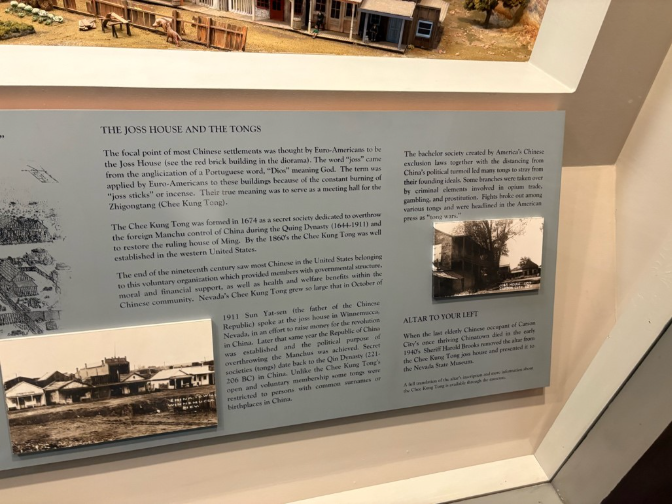
The grand visit of Dr. Sun Yat-sen in 1911 brought the revolutionary leader and father of modern China to this small town. He was traveling across the United States, gathering support and raising money from the overseas Chinese communities and stopped at Winnemucca. He used the Joss House—the community temple—to deliver his powerful speech to the people, inspiring all to see a better, modern, and free China, influencing most of the neighborhood.
Sadly, the decades wore on and as time passed, the community faced many challenges. New generations came along, the old grew, and the younger American-born migrated to larger communities and cities like San Francisco. By the 1900’s, the streets fell silent and Winnemucca got smaller. The final straw was in March 1955, when the Winnemucca city council ordered to demolish the Joss House, erasing the most important structure and symbol of Chinatown.
Today, Winnemucca’s Chinatown lives on purely in memory and those stories, since most physical relics were demolished or lost, but the story says so much more than just local legends and history—it tells us that people were profound enough to make something out of nothing and made history by helping shape the Nevada soil.
Thank you to the Nevada State Museum for providing further insight into this town and for allowing students to learn more about the history of this fascinating community!
Related Link
Joss House demolition, Jun 28, 1954, Reno Gazette-Journal (Reno, Nevada), Newspapers.com
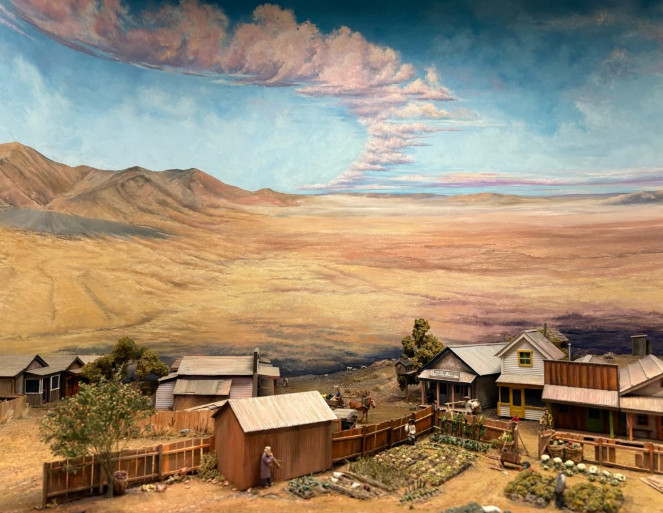
Photo credit: Main photo—Partial Chinatown diorama exhibit. Courtesy of Charbel Ruiz Perez.