Two recent articles (one by This is Reno, and one from Picon Press Media) have discussed the issue that is not exclusive to Sun Valley, but that always seems to be associated with us—abandoned properties, and the illegal dumping and squatting (illegal camping) that occur thereon.
What is an abandoned property? Simply put, it’s likely a parcel of land where the owner has died, with no known next of kin (or no probate action started). Another scenario is where the land was owned by a company, but the company has since been dissolved. Legally, the county cannot just sell or auction off these particular properties, since 1) they don’t technically own them, 2) there may have been issues with correctly transferring the deeds (explained further below), and 3) the County may not want to own them because of the cost and effort to maintain them over the years (this applies mostly to the roadway parcels).
Basically, this just means that the county currently doesn’t have the authority to enforce county code violations on these pieces of land. And yet, the lands don’t just revert back to public land, either. Truly, there is no one responsible and no one to blame or hold accountable when something goes wrong.
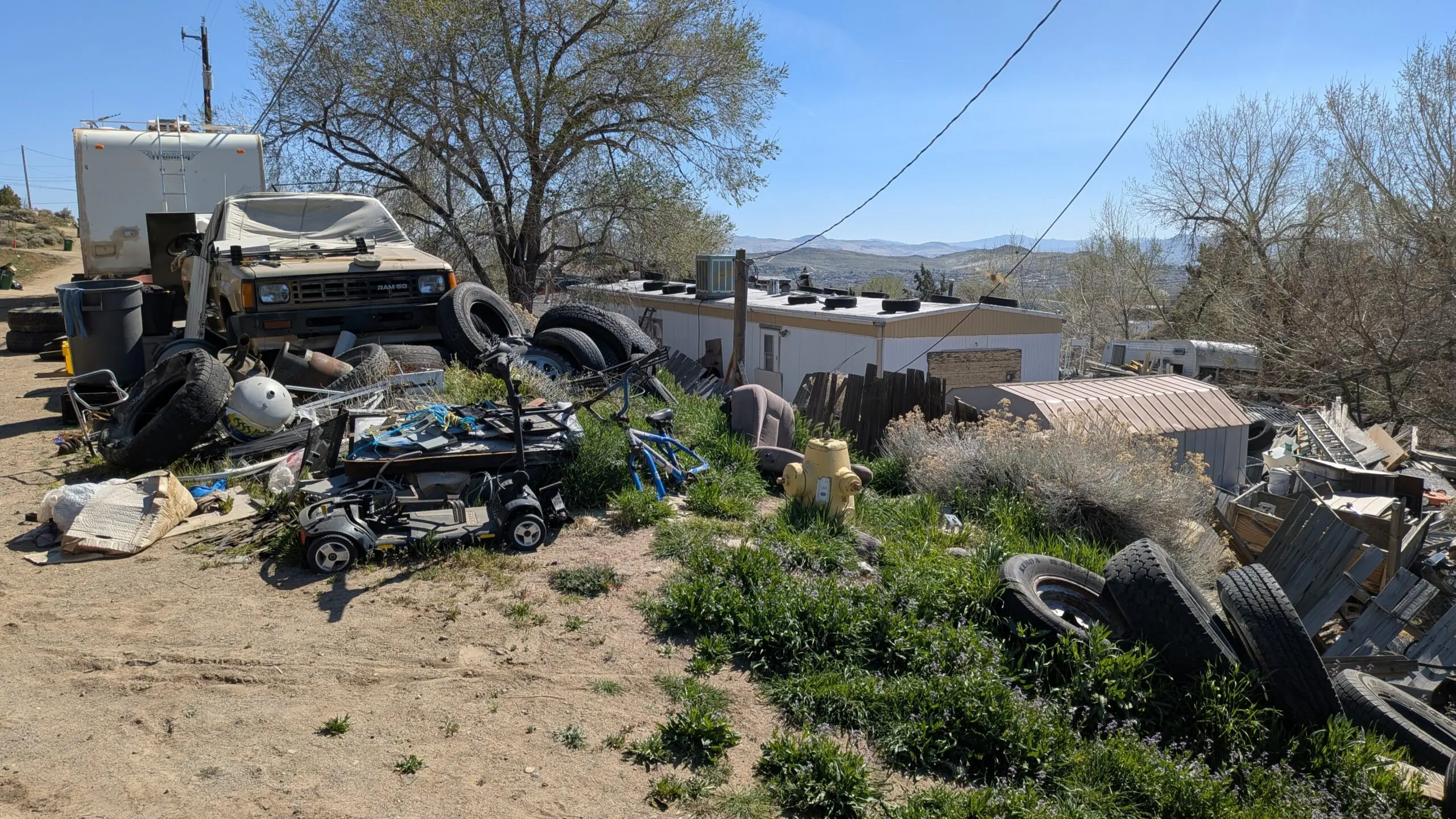
This situation creates an opportunity for some people to abuse these plots of land by dumping abandoned vehicles, trash, propane tanks, hazardous materials, and even human waste—much to the displeasure of neighbors. Sometimes, they go further and squat on the property, and there are rumors of suspected drug activity, homeless camps, and at least two recent structure fires at some of these locations. The unfortunate loophole that enables these situations to exist needs to be closed, for the good of neighbors and the community.
In an interview with KOLO TV from 2020, Washoe County Sheriff’s Office representative Captain Don Gil stated, “The vehicles that are dumped on private property pose a real problem just because… Who’s responsible for that car? We don’t have the authority to just go grab that car and tow it.” Depending on location, and without the title and DMV paperwork, these vehicles often cannot be moved legally.
However, Nevada Assembly Bill 415 (signed into law on October 1, 2025), co-sponsored by Heather Goulding (the Nevada State Assemblymember who represents Sun Valley in District 27), speeds up removal of abandoned cars, and reduces cost for the county to do so, by eliminating much of the red tape required to get these vehicles towed away. The new law enables quicker removal of unregistered, abandoned vehicles likely to be valued as “junk” (7-day notice), modifies provisions on when the DMV can issue junk certificates for towed vehicles, revises procedures for handling abandoned vehicles on private property to ensure legal compliance for owners, raises the junk-vehicle threshold from $200 to $500, allows tow operators to appraise vehicles, and eliminates many notification & ownership-search requirements.
But in a town where many people say “mind your own business,” why does it matter what happens on these pieces of land? Simple: These plots are in residential areas, usually with neighbors living on all sides. Some of the properties are in close proximity to elementary schools or churches. If an abandoned trailer catches fire, it threatens all the neighbors and/or nearby buildings. If a child or animal gets hurt playing around the trash or in decrepit RVs, campers, etc., there is no one to hold accountable. And of course, property values of surrounding homes can be affected. They can become a fire hazard, safety issue, eyesore, and a public nuisance.
This is Reno recently produced a well-crafted YouTube video that explains the issue here in Sun Valley:
In it, they interviewed Washoe County Commission Vice Chair Mariluz Garcia, who discusses some of the intricacies of this problem, and what the county is now pursuing to resolve this issue going forward. To be fair, a lot of work has already gone into cleaning up some of these parcels over the past three years, with clean-ups and abatement efforts on the part of Commissioner Garcia, Washoe County, WCSO, Keep Truckee Meadows Beautiful (KMTB), Hero Environmental Services, Desert Pigs (Reno North Valleys Chapter), and various corporate sponsors.
In the November 16, 2021 meeting of the Board of County Commissioners (BCC), Chief Deputy Greg Herrera and Captain Marc Bello from WCSO (Washoe County Sheriff’s Office) specifically talked about a nuisance property located on Quartz Ln in Sun Valley. To be clear, the Sheriff’s Office has already done due diligence in researching property and vehicle owners on many parcels like this one, but it’s not as simple as just calling a tow truck to haul abandoned cars to a junkyard.
In December 2025, Chris Melton representing SVGID (Sun Valley General Improvement District) supported a request by Sergeant Sonia Butler representing WCSO, formally asking Washoe County for monies in 2026 to specifically remove abandoned vehicles, motorhomes, boats, and garbage within the Sun Valley community.
In the January 13, 2026 meeting of the County Commissioners, Assistant County Manager Dave Solaro presented to the board, and they voted affirmatively & unanimously to grant extra staff time (“more than four hours”) across many different county departments (such as the DA’s office, Treasurer, Assessor, Public Administrator, WCSO H.O.P.E. team, etc.) to investigate options to see if individual parcels can and/or should be reviewed for transfer of ownership to Washoe County or adjacent property owners. The result of this action should be a potential legal path forward to change ownership of orphaned parcels. Possible solutions include seeking quiet-title actions, correction deeds, or County reclamation, so parcels return to the tax rolls and become enforceable.
The 2017 Rescission of Tax Deeds
Thirty-seven (37) orphaned parcels in Sun Valley were ‘created’ by the 2017 rescission of Treasurer’s Tax Deeds. In 2017, the Washoe County Treasurer executed a rescission of certain tax deeds, a relatively rare administrative and legal action involving properties that had been deeded to the County Treasurer in trust due to delinquent taxes. This process is generally governed by Nevada Revised Statutes (NRS) 361.585, which allows the Treasurer to hold property in trust when taxes remain unpaid for three consecutive years.
The 2017 actions were largely centered around correcting administrative errors or addressing specific parcels where the deeding process was found to be legally or factually flawed. Under NRS 361.765, the Washoe County Board of County Commissioners has the authority to direct the Treasurer to correct clerical or factual errors on the tax rolls. In several instances in 2017, deeds were rescinded because the underlying tax delinquency was based on an incorrect assessment or a failure to properly notify the rightful owner. (I imagine it’s difficult to notify a rightful owner if they are dead…)
Some rescissions occurred because the property in question was deemed “unmarketable” or had been deeded to the County in error (e.g., properties that should have been exempt or were part of ongoing probate disputes). Regarding a parcel near Quartz Ln, the County rescinded the tax deed, effectively returning the property to the private sector (specifically the original heirs). This move caused local controversy because, once the County rescinded the deed, it no longer had the responsibility (or authority) to maintain the property or mitigate hazards like fire risks, leading to complaints from neighbors.
To be clear, rescinding a deed removes the County’s liability for property maintenance and safety issues, so it’s understandable why they did this, but I believe they legally needed to because of clerical errors (incorrect valuations or owner names) or notification failures (cases where the “Certified Notice of Sale” was not successfully delivered, which would make a County-held deed legally voidable).
The end result of the 2017 rescission action was that it restored ownership to original titleholders (or their heirs) in cases where the tax foreclosure process was found to be technically deficient. Thus, the parcels were no longer under the County’s control. Ownership was back with the original owners (or their heirs, if any), despite the unpaid taxes that landed the parcels in the County’s control for a brief period of time (but even then as a trustee, not the owner).
At the January 13, 2026 BCC meeting, Chief Deputy District Attorney Michael Large commented that investigating chain of title on these 37 Sun Valley properties has already been done, but each individual parcel falls into a different scenario. Thus, it will take additional time to review and determine what the best, most expeditious & legal move is for each unique location, making sure due process is followed.
During the same meeting, Sun Valley CAB Chair Heidi Soper, and Candidates Katherine Yriarte and Veronica Cortes all spoke in support of closing this loophole and getting these parcels cleaned up.
Where Are These Orphaned Parcels Located?
The 37 specific properties in Sun Valley have been identified by the H.O.P.E. team and Code Enforcement, and outlined here by Washoe County Commissioner Mike Clark:
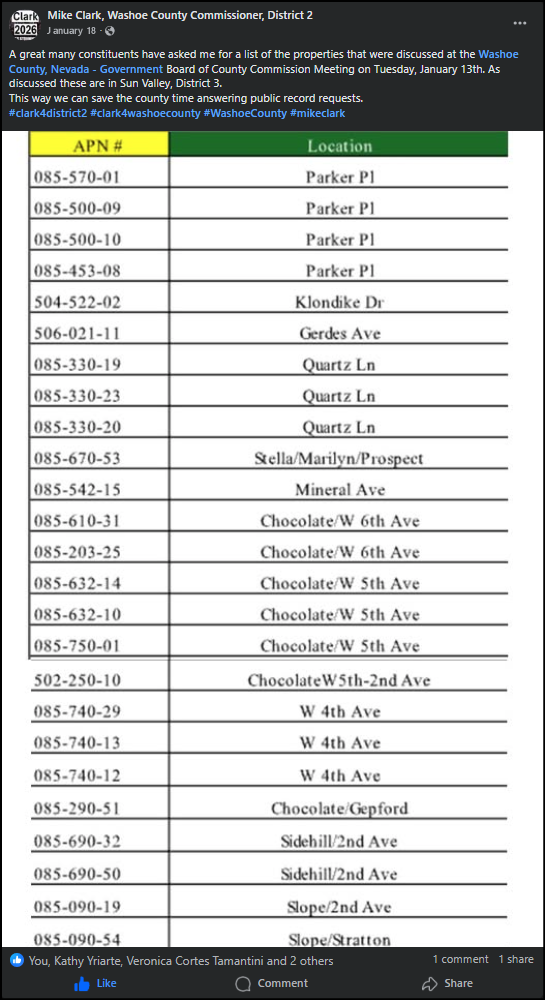
To view details about a specific APN (Assessor’s Parcel Number), you can use the online Real Property Assessment Data tool provided by the Washoe County Assessor’s Office. Note: In order to view official records images (such as deeds, maps, declarations of value, etc.), you’ll need to create a free account with the Washoe County Recorder’s Office.
Related Links:
County commissioners to explore options for Sun Valley’s abandoned properties (This is Reno)
Sun Valley’s Zombie Properties and the County That Forgot Its Own Records (Picon Press Media)
Something Important is Happening in Sun Valley (Facebook post by Commissioner Mariluz Garcia)
Illegal dumping causing issues for people in Sun Valley (KOLO)
Sun Valley Abandoned Vehicles Project (pdf; WCSO)
Washoe County Abandoned Vehicle Abatement Program in Sun Valley (pdf; WCSO)
Assembly Bill No. 415 (2025; Full Text; Nevada State Legislature)